
Why is water dripping from my ceiling after it rains
Water dripping from a ceiling after rain usually, but not always, means a roof leak. This guide explains the pathways, how roof, plumbing, and condensation sources differ, and the immediate safety steps.
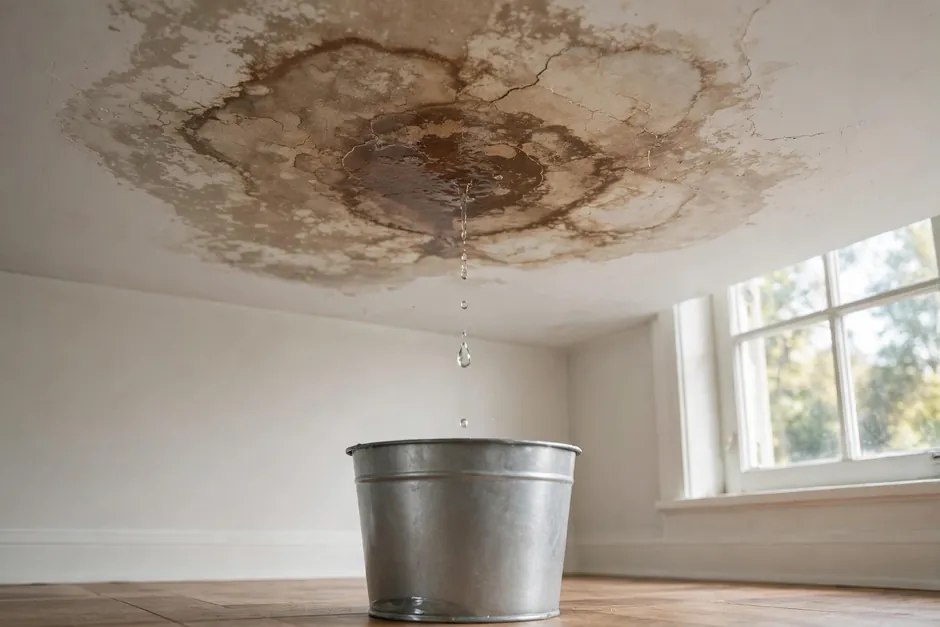
Why is water dripping from a ceiling after it rains? In South Bend, the usual pathway is a roof leak: water enters through flashing, damaged shingles, or another roof joint, travels along decking, rafters, and insulation, and shows inside at a ceiling point that may sit far from the entry. This guide explains the pathways, how roof, plumbing, and condensation sources differ in general terms, and the immediate steps to take.
No diagnosis is offered here. Ceiling water has more than one possible source, and the source is confirmed by inspection, not assumed from the stain. The sections below keep the pathways separate so the right questions can be asked.
Why water drips from your ceiling after rain in South Bend
Water drips from a ceiling after rain because water has found a path through the roof assembly and the ceiling below it. The entry point is on the roof or at a roof joint. The drip point is where water has collected enough to break through paint and drywall. The two points are often offset, because water travels before it shows.
Rain-linked timing is the first clue, not proof. Water that appears during or shortly after rain points toward a roof pathway. Water that appears without rain, or that persists in dry weather, points elsewhere. Timing narrows the question. Inspection answers it.
A roof inspection covers the surface, flashing, penetrations, gutters, and attic together, which is how the pathway is traced. See leak detection and repair for how sources are traced professionally.
The most common causes of a ceiling leak after rain
The causes below are the general pathways for rain-linked ceiling water. Each is checked separately during an inspection.
1. Failed flashing around chimneys, vents, and skylights
Flashing turns water away where the roof meets something else: chimneys, walls, vents, and skylights. Failed flashing at any of those joints lets water in at the joint, and the water travels before showing inside. See chimney flashing repair for the chimney joint.
2. Missing or lifted shingles
Missing, lifted, cracked, or displaced shingles open the covering to water. Wind and hail damage shingles in ways that are not always visible from the ground, and seals broken by wind let water under tabs that look intact. See what to do after wind damage knocks shingles off a roof.
3. Clogged or failing gutters
Clogged or failing gutters hold water at the eave, where it backs up under edge shingles and into fascia and soffit. Granules and debris in gutters, and water overflowing the edge in rain, are the visible signs. See gutter cleaning for the drainage side.
4. Ice dams
Ice dams form when attic heat melts snow that refreezes at the eave, holding meltwater back under shingles. Ceiling water that appears after snow has sat on the roof, near eaves and exterior walls, fits the ice-dam pathway. See how to prepare a roof for a South Bend winter for the mechanism.
5. Skylight seals
Skylight seals and flashing fail at the joint where the skylight meets the roof, and at the seals within the unit. Water at a skylight shows as staining around the opening or dripping from the frame. See skylight repair for the skylight side.
6. Roof age and shingle failure
Worn shingles, granule loss, curling, and cracking across the roof let water through the covering itself, rather than at a single joint. Wear is assessed across slopes, not from one shingle, and no age threshold is stated here. An inspection records wear in writing.
How to stop water dripping from your ceiling right now
Immediate steps are interior ones. The goal is to limit damage and stay safe while an inspection is arranged, not to fix the roof from inside.
- Place containers under drips. Buckets and sheeting catch water and protect floors and belongings. Move furniture and valuables from the drip path.
- Avoid swollen or sagging ceilings. A ceiling holding water can release suddenly. Keep clear of swollen areas and do not cut into the ceiling.
- Keep electrical safety in mind. Where water meets light fixtures, outlets, or switches, avoid the area and seek qualified advice before touching switches or fixtures.
- Photograph and note. Photograph the drip, the stain, and the attic above where access allows, with the date and the rain timing noted. The record supports the inspection.
- Arrange an inspection. A roof inspection traces the pathway with the surface, flashing, and attic checked together. Describe the timing and location when calling.
See emergency roof repair for urgent water entry within business hours. For temporary measures while a roofer is arranged, see how to patch a small roof leak before calling a roofer, framed as temporary steps only.
Is a ceiling leak always from the roof?
No. A ceiling leak is not always from the roof. Plumbing leaks and condensation can both show as ceiling water, and the pathways differ in timing, location, and attic signs. The table below is general education, not a diagnosis.
The distinctions, in general terms:
- Plumbing pathways. Leaks from pipes and fixtures show without rain, often near bathrooms and kitchens, and persist in dry weather. Timing without rain points away from the roof.
- Condensation pathways. Attic condensation shows as moisture or frost on the underside of the deck, often with ventilation and air-movement causes, and may appear in cold weather without a roof entry point.
- Roof pathways. Rain-linked timing, entry at flashing, shingles, gutters, ice dams, or skylights, and water that travels along decking before showing inside.
An inspection that covers the roof, the attic, and the interior separates the pathways. See leak detection and repair for tracing, and why a roof leaks around the chimney where the stain sits near a chimney.
What to watch out for: mistakes that make ceiling leaks worse
Mistakes with ceiling leaks usually come from treating the stain instead of the pathway:
- Painting over the stain. Paint covers the symptom and makes the next inspection harder. The stain records where water arrived.
- Cutting into a swollen ceiling. A ceiling holding water can release suddenly. Keep clear and arrange professional help.
- Assuming a single source. More than one pathway can contribute. The inspection checks roof, attic, and interior together.
- Delaying documentation. Photographs and notes taken close to the event, with timing recorded, support the inspection and any later conversation.
- Ignoring the attic. Attic moisture, staining, and daylight show the pathway. A surface-only look leaves the pathway open.
For repair scope once the pathway is traced, see roof repair. For the decision between repair and replacement, see how to tell if a roof needs repair or full replacement.
When to call a professional for ceiling leak repair
Call a professional when water is actively dripping, when a ceiling looks swollen or sagging, when staining spreads or recurs after rain, or when the source is unclear after a ground and attic look. Those are signs that the pathway needs tracing.
Quality Roofing LLC is a roofing contractor at 63251 Mulberry Rd, South Bend, IN 46614. Calls are answered during business hours: Mon-Fri 7 AM-7 PM and Sat 8 AM-8 PM, closed Sunday. The business holds 5.0 stars from 23 Google reviews.
Describe the timing, the location, and what you have observed when calling. A roof inspection traces the pathway, and leak detection and repair covers the tracing scope.
Call (574) 901-6308 during business hours to discuss an inspection for a ceiling leak in your South Bend home.
Frequently asked questions
Why is water dripping from my ceiling after it rains in South Bend IN?
Usually a roof pathway: failed flashing, damaged shingles, clogged gutters, ice dams, or skylight seals letting water travel along decking and framing before showing inside. Plumbing and condensation can mimic a roof leak, so the source is confirmed by inspection, not assumed.
How do I stop a ceiling leak in South Bend Indiana?
Control water inside first: containers, moved belongings, and caution around swollen ceilings and electrical fixtures. Then arrange an inspection to trace the source. Stopping the drip inside does not stop the entry point.
Is a ceiling leak always from the roof in South Bend IN?
No. Plumbing leaks and condensation can both show as ceiling water. Rain-linked timing points toward the roof, but timing alone does not prove the source. An inspection that covers the roof, attic, and interior separates the pathways.
What should I ask when calling about ceiling water damage in South Bend Indiana?
Ask what the visit covers, whether the roof, attic, and interior are checked together, and whether findings arrive in writing with photographs. Describe the timing, the location, and what you have observed.
What affects the cost of roof leak repair in South Bend?
The entry point and its extent, whether flashing, decking, or skylight work is involved, roof pitch and access, and interior scope. This site publishes no prices. A written scope for the specific leak is the way to compare.
Get help with roofing in South Bend
Pathway first, repair second. Call Quality Roofing LLC at (574) 901-6308 during business hours to discuss an inspection for a ceiling leak in your South Bend home.