
Flat roof vs pitched roof: which is right for your South Bend business
Choosing between a flat roof and a pitched roof for a South Bend business comes down to the building, drainage, snow load, and maintenance. This guide compares the considerations without prices or lifespan figures.
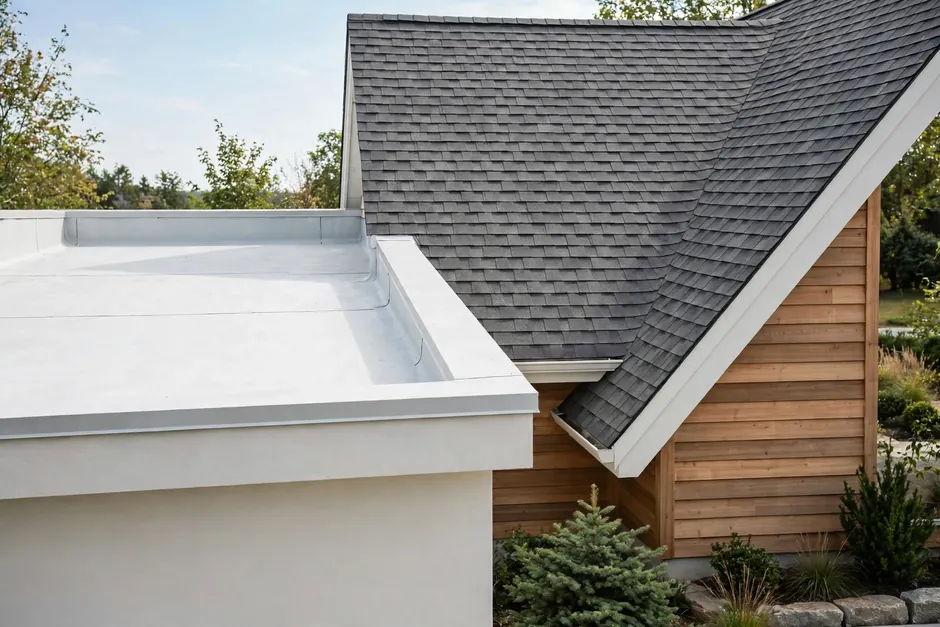
Flat roof vs pitched roof, which is right for your South Bend business, is a question the building itself largely answers: footprint, structure, drainage, and use. This guide compares the considerations for commercial buildings in South Bend, including the downtown commercial core, without prices, lifespan figures, or a verdict that fits every building.
The short answer: flat vs pitched for South Bend businesses
For most South Bend businesses, the comparison turns on three factors: how water and snow leave the roof, what the existing structure supports, and what maintenance the system needs. A flat roof, more precisely a low-slope roof, moves water slowly toward drains and scuppers. A pitched roof moves water and snow by gravity toward eaves and gutters.
Large footprints, rooftop equipment, and the existing framing usually point toward keeping the roof form the building was designed for. Changing from one form to the other raises structural questions that belong to a qualified assessment, not to a general guide. See commercial roofing for the commercial side, framed as education.
How South Bend weather shapes the decision
South Bend sits in a lake-effect snow belt downwind of Lake Michigan. The 1991-2020 normals for the South Bend station are 64.5 inches of snowfall a year, with recent seasons ranging from 39.0 inches in 2021 to 91.8 inches in 2022. The adopted code sets a 30 psf ground snow load and a 115 mph wind speed for St. Joseph County, with an ice barrier requirement. Snow load and drainage shape the comparison for both roof forms.
Freeze and thaw cycles work water into joints, seams, and flashing on either form. On a flat roof, the concern is water that remains after rain or snowmelt and the detailing at drains, seams, and penetrations. On a pitched roof, the concern is ice at eaves and valleys and the condition of flashing. Either form depends on detailing at joints more than on the field of the roof.
Flat roof pros and cons for South Bend businesses
Flat roof considerations for South Bend businesses center on drainage, usable space, and access. The lists below separate the advantages from the constraints.
Flat roof pros
- Usable roof space. HVAC units, vents, and rooftop equipment sit on a flat roof without the staging a steep slope requires.
- Straightforward access. Inspections and maintenance checks are carried out on a walking surface, subject to membrane care and fall protection at edges.
- Large footprints. A low-slope roof covers a large rectangular footprint without the framing a pitched roof would require.
- Drainage design. Drains, scuppers, and tapered falls are designed as a system, and the design is part of the scope conversation.
Flat roof cons
- Standing water risk. Poor drainage leaves ponding, which stresses membranes, seams, and flashing. Drainage must be designed and kept clear.
- Seam and flashing attention. Seams, penetrations, and edge details need regular checks, because water leaves slowly and finds weak joints.
- Snow load awareness. Snow sits on a flat roof until it melts or is addressed. Load and drainage after snow events need attention, without presenting snow work as a routine service here.
For the flat and low-slope comparison, including EPDM, TPO, and modified bitumen described generally, see flat roofing. For the membrane comparison, see rubber roofing vs TPO for flat roofs in South Bend. Neither page claims installation of any specific system.
Pitched roof pros and cons for South Bend businesses
Pitched roof considerations center on drainage by gravity, snow behavior, and the existing framing. The lists below separate the advantages from the constraints.
Pitched roof pros
- Natural drainage. Gravity moves water and snow off the roof toward eaves and gutters, reducing the time water sits on the surface.
- Snow shedding. Steeper pitches shed snow more readily, subject to ice behavior at eaves and valleys.
- Familiar detailing. Shingle, flashing, and valley details are well understood, and wear signs are visible from the ground and the attic.
- Curb presence. For customer-facing buildings, a pitched roof is part of the street presence, where the building form supports it.
Pitched roof cons
- Access demands. Inspections and repairs on steep slopes require fall protection and careful staging.
- Less usable space. Rooftop equipment needs curbs and staging that a flat roof does not require.
- Ice at eaves and valleys. Ice dams and valley ice affect pitched roofs where attic conditions and flashing allow, and the ice barrier requirement applies.
If a building already has a pitched roof and replacement is being weighed, the existing framing, deck, and flashing govern the scope. See roof replacement for the permit and code side of a re-roof.
Flat roof vs pitched roof cost in South Bend: drivers
No prices are stated in this guide. Cost follows scope: footprint and structure, drainage design, membrane or covering specification, tear-off or overlay method, deck condition, and access. A flat roof and a pitched roof on the same building are rarely comparable scopes, because the structure and drainage differ.
Comparing install scope alone also misleads. Ongoing scope, drainage checks, seam and flashing attention on a flat roof, and shingle, flashing, and valley attention on a pitched roof, belongs in the comparison from the start.
A written scope for the specific building, following an inspection, is the way to compare. A roof inspection records the surface, drainage, flashing, and deck condition that the scope rests on.
Which roof is better for your type of business?
Building type shapes the considerations, but the existing structure governs. The notes below are starting points for the conversation, not prescriptions.
- Warehouse or distribution center. Large footprint and rooftop equipment are the usual considerations. The existing structure and drainage design govern what fits.
- Retail strip center. A flat roof is the common existing form, with drainage and equipment access as the considerations. A pitched section, where one exists, is assessed on its own terms.
- Restaurant or small office. Street presence and existing form matter alongside drainage. A pitched roof suits buildings framed for it. A flat roof suits buildings designed for equipment and access.
- Church or school. Mixed forms are common, with flat sections over halls and pitched sections over other wings. Each section is assessed separately.
- Multi-tenant building. Access, drainage, and phasing around occupants are the considerations, alongside the existing structure.
Downtown South Bend illustrates the commercial-core side: masonry commercial buildings, generally two to three stories in earlier stock and taller later, within the central business district framing of the 2016 Parking Study, from Marion Street north to Western Avenue, Lafayette Boulevard to the river, labelled here as that study's framing. See roofing in downtown South Bend for the commercial-core page, which carries no residential claims. Start with commercial roofing for the education framing.
Common mistakes when choosing a commercial roof
The expensive mistakes in choosing a commercial roof come from deciding on material or price before the building has been assessed: structure, deck, drainage, and flashing.
Other mistakes to avoid:
- Skipping the deck and structure check. If the underlying structure is soft or damaged, a new covering does not correct it. Deck condition belongs in the scope conversation.
- Ignoring drainage. A flat roof needs drains, scuppers, and falls that work as a system. A pitched roof needs gutters and valleys that move water away. Drainage design is part of either scope.
- Assuming a form change is straightforward. Adding slope to a building not framed for it, or flattening a pitched roof, raises structural questions for a qualified assessment.
- Deferring maintenance checks. Drainage, seams, flashing, and gutters need regular attention on either form. Deferral turns small detailing issues into larger scope. See roof maintenance for the ongoing-care side.
When to call a professional
Call a professional when you see water that remains after rain, interior ceiling stains, seams or flashing that have lifted, or sagging in the roof line. Those are signs that the roof needs a closer look.
Quality Roofing LLC is a roofing contractor at 63251 Mulberry Rd, South Bend, IN 46614. Calls are answered during business hours: Mon-Fri 7 AM-7 PM and Sat 8 AM-8 PM, closed Sunday. The business holds 5.0 stars from 23 Google reviews. Call (574) 901-6308 during business hours to discuss an inspection for your building.
Frequently asked questions
Is a flat roof or pitched roof better for a business in South Bend IN?
Neither is better in general. The existing structure, footprint, drainage, and use of the building govern the comparison. A flat roof suits large footprints and rooftop equipment. A pitched roof sheds water and snow by gravity. The specific building decides.
What affects flat roof cost vs pitched roof cost in South Bend Indiana?
Footprint and structure, drainage design, membrane or covering specification, tear-off or overlay method, deck condition, and access. This site publishes no prices. A written scope for the specific building is the way to compare.
What affects how long a flat roof lasts on a commercial building in South Bend IN?
Drainage, seam and flashing detailing, membrane specification, snow and ponding exposure, and ongoing checks. No lifespan figure is stated here, because none was sourced for this guide.
What should I ask about commercial flat roofs in South Bend Indiana?
Ask how drainage is designed, how seams and flashing are detailed, what inspection and maintenance the system needs, and what registration and insurance paperwork the contractor can show. Ask for a written scope.
Does a flat roof need more maintenance than a pitched roof?
A flat roof needs regular attention to drainage, seams, and flashing, because water leaves more slowly than on a pitched roof. A pitched roof needs attention to shingles, flashing, and valleys. Neither is maintenance-free. No fixed schedule is stated here.
Get help with roofing in South Bend
The right call starts with the building: structure, drainage, and flashing, recorded in an inspection. Call Quality Roofing LLC at (574) 901-6308 during business hours to discuss an inspection for your South Bend business.